.png)
BIS Guidelines IS 16102
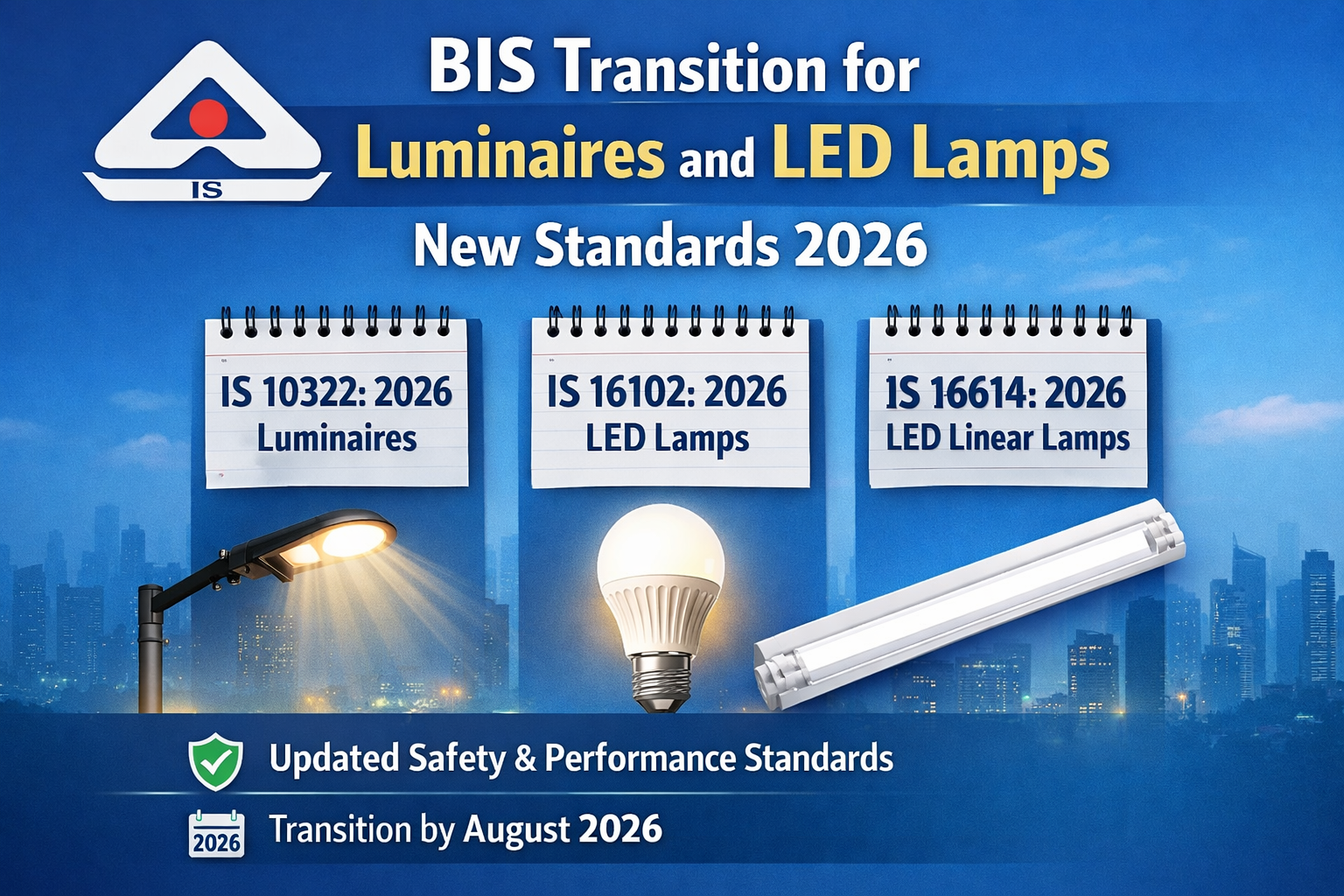
The Bureau of Indian Standards (BIS) has revised the existing standard IS 16102 (Part 1):2012 and released the updated version IS 16102 (Part 1):2026. This revision aims to improve safety, performance, and testing requirements for LED lamps used in India. The new standard introduces several technical changes to ensure better product quality, improved consumer safety, and alignment with modern lighting technologies.
Manufacturers, importers, and license holders dealing with LED lamps must comply with this revised standard before the deadline specified by BIS. The last date for the concurrent running of both standards is 02 August 2026, after which the old standard IS 16102 (Part 1):2012 will be withdrawn completely.
IS_16102_Part_1_guidelines
This update is important for companies manufacturing or importing LED lighting products, as non-compliance may lead to cancellation of BIS licenses or removal of products from the license scope.
Overview of IS 16102 (Part 1)
IS 16102 is an Indian standard that specifies the safety requirements for LED lamps used for general lighting services. It ensures that LED lamps meet certain quality, safety, and performance criteria before they are sold in the Indian market.
The revised IS 16102 (Part 1):2026 introduces additional testing requirements and improved safety measures to keep up with technological advancements in LED lighting products.
The update mainly focuses on:
Expanding power coverage
Introducing new safety tests
Improving labeling requirements
Adding performance checks for LED lamps
These revisions help ensure safer products for consumers while maintaining consistent product standards across manufacturers.
Important Implementation Timeline
BIS has provided a transition period to allow manufacturers and license holders to comply with the updated requirements.
Key timelines include:
Old Standard: IS 16102 (Part 1):2012
Revised Standard: IS 16102 (Part 1):2026
Last date for concurrent use: 02 August 2026
After this date:
The old standard will be withdrawn.
All products must comply with the revised standard.
Non-compliant licenses may be cancelled.
This transition period allows manufacturers enough time to update product designs, testing procedures, and compliance documentation.
Guidelines for Existing BIS License Holders
Existing license holders must upgrade their products and documentation to comply with the revised standard before the implementation deadline.
The following actions are required:
1. Compliance with Revised Standard
All existing licensees must ensure their products conform to IS 16102 (Part 1):2026 before 02 August 2026.
2. Submission of Test Reports
Manufacturers must submit updated test reports issued by BIS-recognized laboratories for all lead models that were previously tested under the old standard.
3. Declaration for Other Models
License holders must submit an undertaking stating that the revised requirements have been implemented for all related series models covered under their license.
4. Consequences of Non-Compliance
If the licensee fails to complete the required actions before the deadline, BIS may:
Cancel the license
Remove specific models from the license scope
These measures ensure that only compliant products remain available in the market.
Guidelines for New Applicants
BIS has also provided instructions for companies applying for new licenses.
Applications Already Submitted
Applications where product samples have already been submitted to laboratories may still be processed under the old standard.
New Applications
New applications may be processed under either the old standard or the revised standard, but only until the implementation deadline.
However, applicants choosing the old standard must provide a declaration stating they will comply with the revised standard before the final implementation date.
After 02 August 2026, BIS will not grant any license based on the old standard.
Key Technical Changes in IS 16102 (Part 1):2026
The revised standard includes several technical improvements aimed at enhancing safety and performance.
Major updates include:
1. Expanded Power Coverage
The rated input power of LED lamps is now covered up to 60 watts.
2. Photo Biological Safety Testing
New test requirements have been introduced to ensure that LED lamps do not cause harmful biological effects due to light exposure.
3. Coverage of Rechargeable LED Lamps
LED lamps with non-removable rechargeable batteries are now included in the standard.
4. Abnormal Operating Condition Tests
Additional tests have been introduced to verify the lamp’s safety under abnormal operating conditions.
5. Ingress Protection Testing
New testing requirements ensure protection against dust and moisture intrusion.
6. Updated Marking Requirements
Additional labeling requirements have been introduced, including:
Marking for lamps not suitable for water contact
Marking for photo biological safety classification
7. Edison Cap Strength Test
A new axial strength test for Edison caps has been added to ensure better mechanical stability.
8. Modified Fault Condition Testing
The testing procedures for fault conditions have been revised to improve safety evaluation.
These changes ensure that LED lamps meet modern safety standards and provide reliable performance for consumers.
Importance of BIS Compliance
Compliance with BIS standards is essential for manufacturers and importers selling LED lamps in India. BIS certification helps ensure:
Product safety
Quality assurance
Consumer protection
Legal compliance
Failure to comply with updated standards may result in regulatory penalties or cancellation of licenses.
Conclusion
The release of IS 16102 (Part 1):2026 represents a major update to the safety and performance standards for LED lamps in India. Manufacturers and license holders must ensure timely compliance with the revised requirements before 02 August 2026.
By implementing these updated standards, BIS aims to improve product reliability, enhance consumer safety, and ensure that LED lighting products in India meet global quality benchmarks.







:-important-update-for-manufacturers.png)